Repair & Overhaul Verification
Documenting repairs and overhauls with evidence that supports warranty claims, compliance, and lifecycle management.
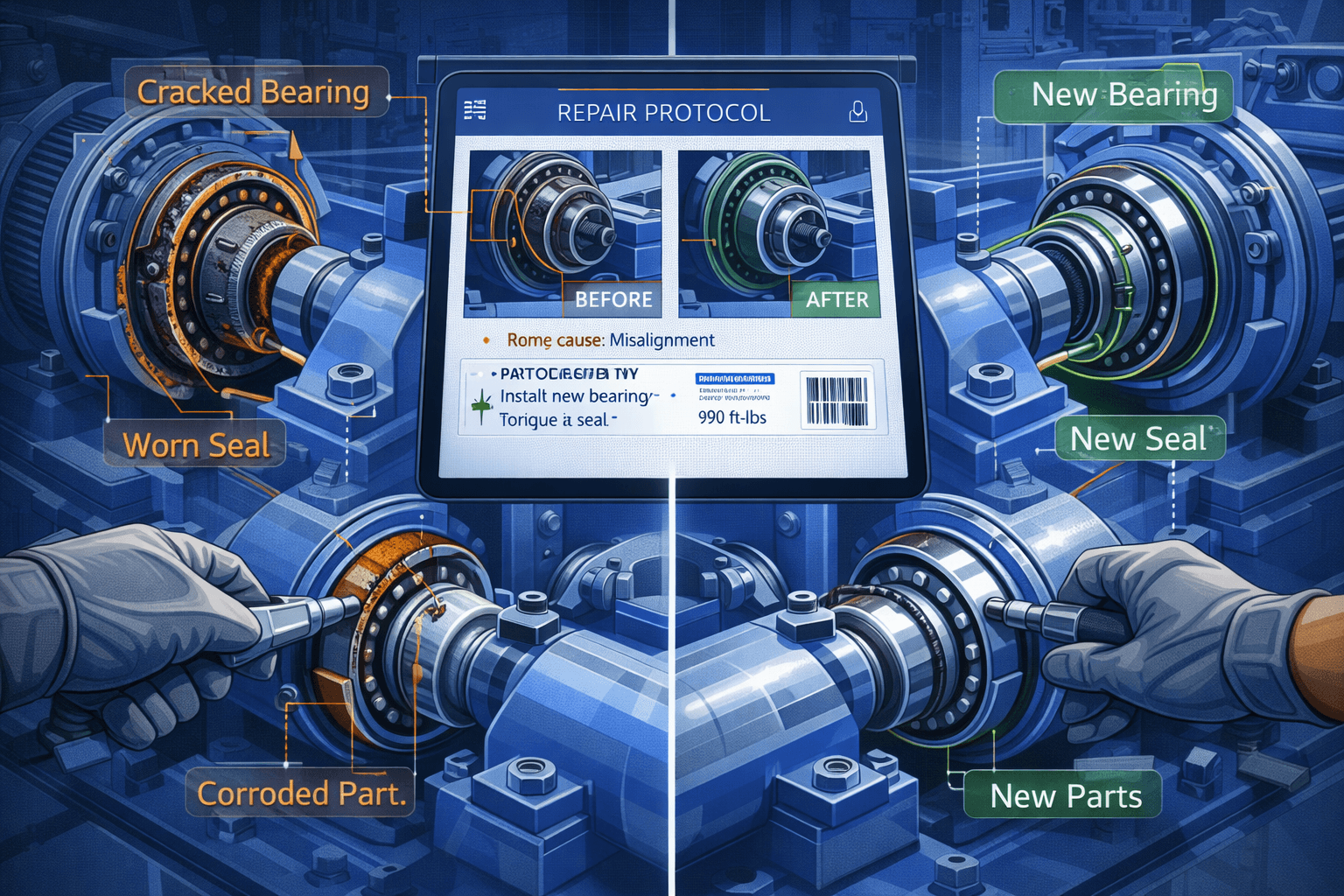
Repairs and Overhauls Restore Functionality
When equipment fails or degrades, repairs restore it to service. Component overhauls return performance to specification. Failure root causes are identified. Worn parts are replaced. Systems are tested and returned to operation.
But when repair work is complete, can you prove what was done? Repair logs document work performed. But logs do not prove repair quality or support warranty claims when failures recur.
The Repair Documentation Problem
Traditional repair documentation creates gaps in accountability:
Root cause analysis without evidence
Report states "bearing failure due to contamination," but where are the photos of the failed bearing? What was the actual contamination?
Replacement parts without traceability
Parts replaced, but were they OEM or aftermarket? What were the serial numbers? Was the replacement part warranted?
Testing incomplete or undocumented
Equipment returned to service, but was post-repair testing performed? Did it meet performance specifications?
Warranty claims rejected
Cannot prove proper repair procedures were followed or OEM parts were used
The result: repeat failures occur because root causes were misdiagnosed, repairs were performed incorrectly, or warranty claims are denied due to insufficient documentation.
Protocol-Driven Repair Verification
Pruved treats repairs as protocols. Every diagnostic step is defined. Every repair action is documented. Every replacement part is traced. Every record is cryptographically sealed.
Engineering Defines Repair Protocols
Your maintenance team encodes repair procedures as protocols. This is not a generic repair checklist. It is a structured definition of how repairs must be performed:
- Diagnostic sequence: Visual inspection, measurements, functional testing to identify root cause
- Evidence requirements: Photos of failed component, measurement data showing failure mode, root cause analysis
- Part specifications: OEM part numbers, torque specs, assembly sequence
- Post-repair testing: Functional tests, performance validation, acceptance criteria
The protocol is versioned. Every repair uses a specific protocol version. Every action is traceable.
The App Guides Technicians Through Repair
Repair technicians use the Pruved app on-site. The app loads the protocol. It guides them through diagnosis and repair. It enforces evidence capture:
- Guided diagnostics: Step-by-step troubleshooting with decision trees
- Real-time evidence capture: Photos of failure mode, part serial numbers, measurements
- Part verification: Scan replacement part to verify OEM specification
- Post-repair validation: Functional tests must pass before completion
Cryptographically Sealed Repair Records
Every repair produces a tamper-evident record that supports warranty claims:
- Failure documentation: Photos and measurements showing failure mode
- Root cause analysis: Evidence supporting diagnosed failure mechanism
- Parts traceability: OEM part numbers, serial numbers, lot codes
- Testing results: Post-repair performance data showing specification compliance
- Timestamp and technician: Who performed the repair and when
This record cannot be altered. It provides cryptographic proof that supports warranty claims and demonstrates proper repair procedures were followed.
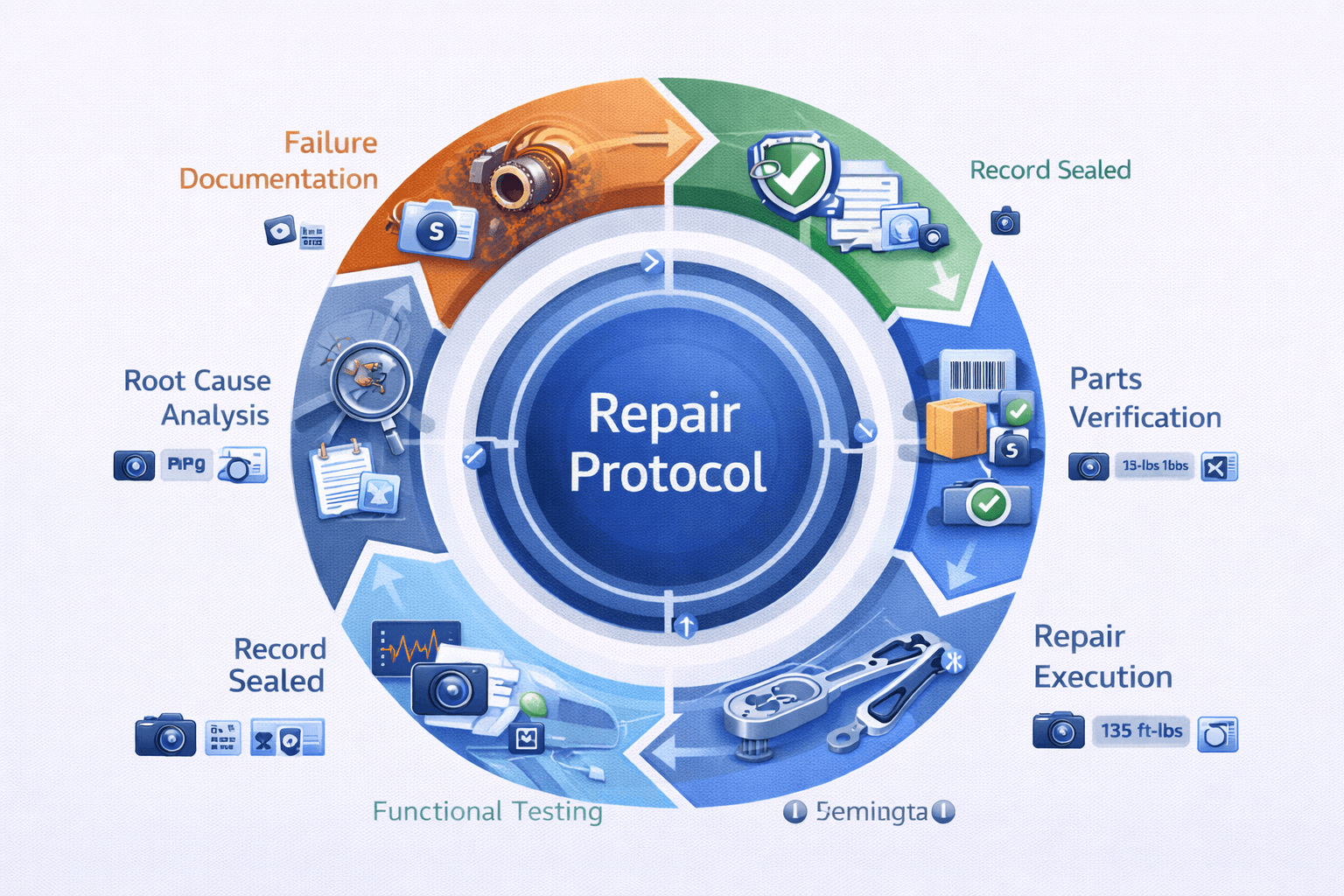
Structured repair workflow ensures consistent execution from diagnosis through post-repair validation
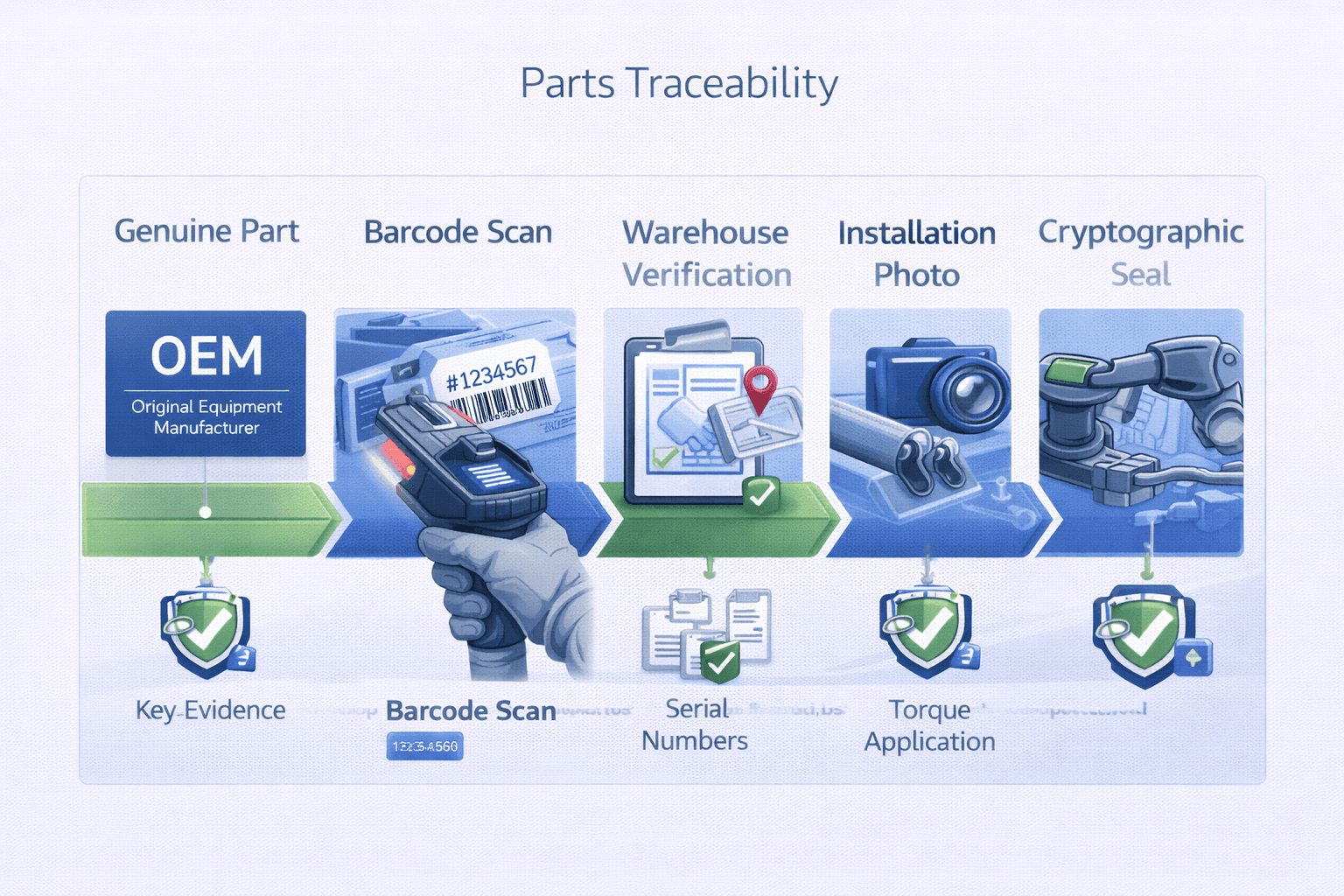
Complete parts traceability links OEM specifications to actual components used in repairs
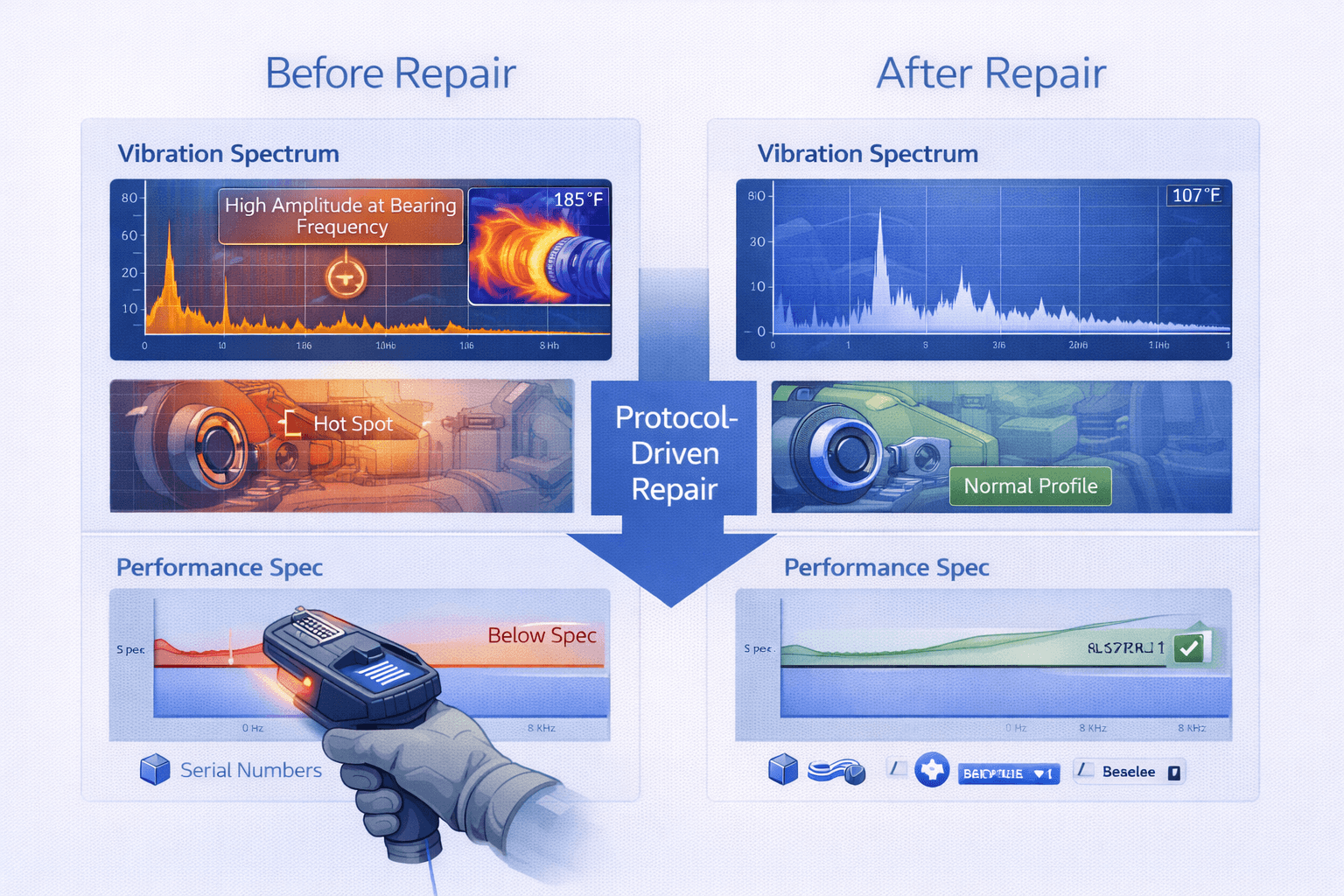
Before and after validation provides objective proof that repairs restored equipment performance
Real-World Repair & Overhaul Applications
Component Overhaul Programs
Scheduled overhauls restore critical components to specification:
- • Disassembly with photographic documentation of wear patterns
- • Dimensional inspection with comparison to new component specs
- • Replacement parts with OEM traceability
- • Reassembly with torque verification and testing
Warranty Repair Documentation
Warranty claims require documented evidence of proper repair procedures:
- • Failure mode documentation with photos and measurements
- • Root cause analysis supported by evidence
- • OEM parts verification with serial number tracking
- • Post-repair testing showing specification compliance
Emergency Repairs
Unplanned failures require rapid response with proper documentation:
- • Failure condition documentation before disassembly
- • Diagnostic testing to identify root cause
- • Repair procedure with evidence of each step
- • Return-to-service testing and validation
Implementing Protocol-Driven Repairs
Start with High-Cost Repairs
You do not need to protocol-ize every repair. Start with repairs where documentation quality matters most:
- • Warranty repairs with frequent claim denials
- • Complex overhauls with multiple steps
- • Critical equipment with high downtime costs
- • Repairs with recurring failures
Document Failure Modes Systematically
Vague failure descriptions like "equipment broke" do not support root cause analysis. Define specific documentation requirements:
- • Photos of failed component before disassembly
- • Measurements showing wear or damage extent
- • Operating conditions at time of failure
- • Previous maintenance history
Integrate with Parts Management
Pruved connects to parts inventory systems. Replacement parts are automatically tracked. OEM verification happens at the point of use. Serial numbers flow into repair records without manual entry.
The Bottom Line
Repair documentation should support warranty claims and prevent repeat failures. Not just work orders that say "repaired." Evidence that proves root cause, proper procedures, and OEM parts.
Protocol-driven repairs provide that evidence. Failure modes documented. Root causes proven. Replacement parts traced. Testing validated. Records sealed cryptographically.
When a warranty claim is filed or a failure recurs, you have proof that the repair was done correctly.
Ready to Document Your Repairs?
See how protocol-driven repair documentation supports warranty claims and lifecycle management.
Get Started