Production Line Verification
How manufacturers ensure every unit meets specification with tamper-proof evidence from the production floor.
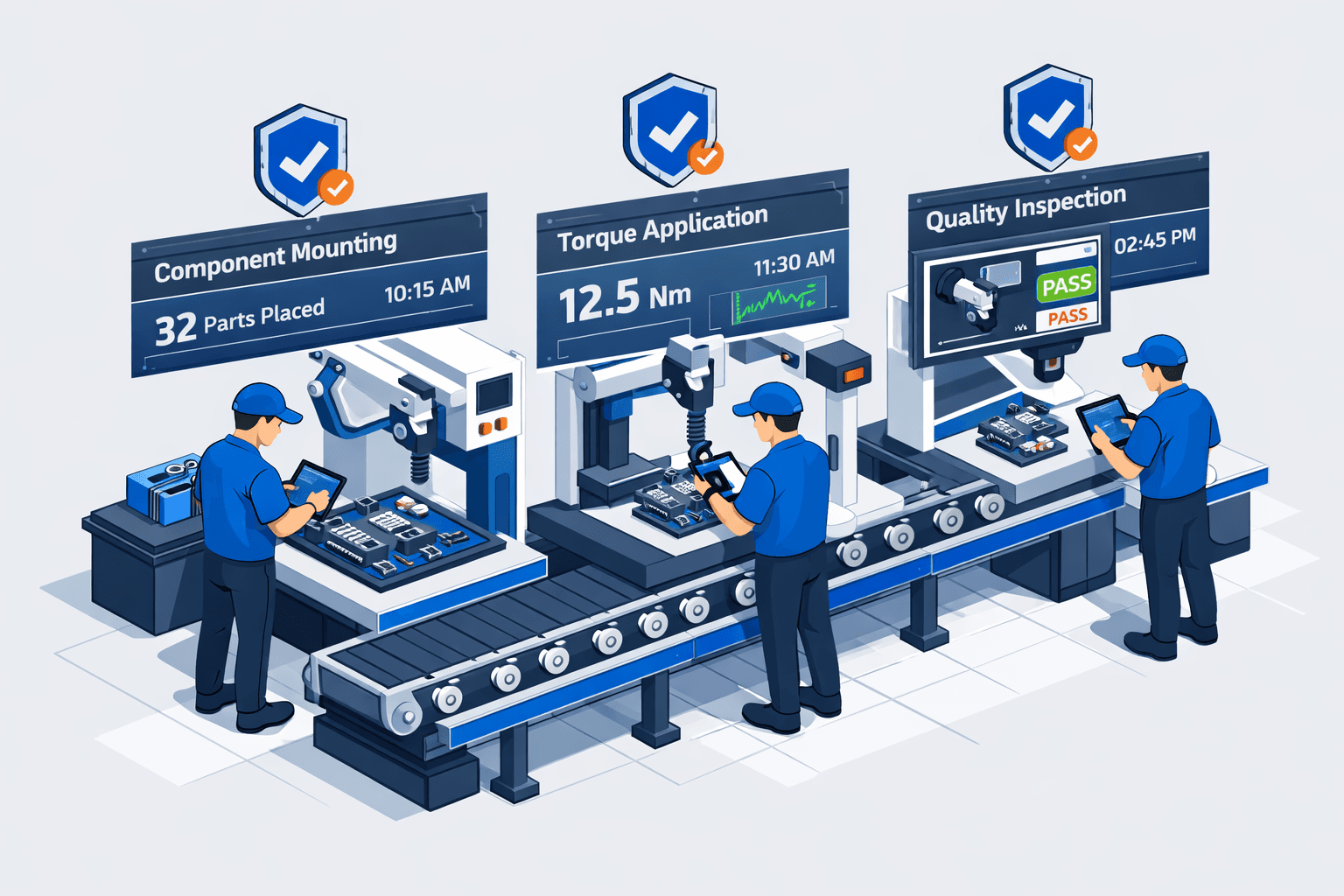
The Production Floor Reality
On a modern production line, hundreds of steps happen in sequence. Each step has specifications. Each specification has tolerances. And every unit must meet every spec, or quality suffers.
The problem is not the specifications themselves. The problem is proving they were followed, unit after unit, shift after shift, across multiple lines and facilities.
What Goes Wrong Without Verification
Without cryptographic verification, production records are vulnerable:
Post-production completion
Operators fill out paperwork after the shift, relying on memory rather than real-time capture
Batch approximation
One record covers multiple units, hiding unit-level variations
Missing evidence
Critical measurements are recorded as numbers without supporting sensor data or photos
Editable records
Paper forms and spreadsheets can be modified after production without trace
When a quality issue surfaces downstream (or worse, in the field), you cannot definitively prove what happened during production. Was the torque actually applied? Was the component genuine? Was the sequence followed?
Protocol-Driven Production Verification
Pruved brings protocol enforcement to the production floor. Engineering defines the production protocol once. Every execution follows that protocol. Every step is verified with evidence. Every record is cryptographically sealed.
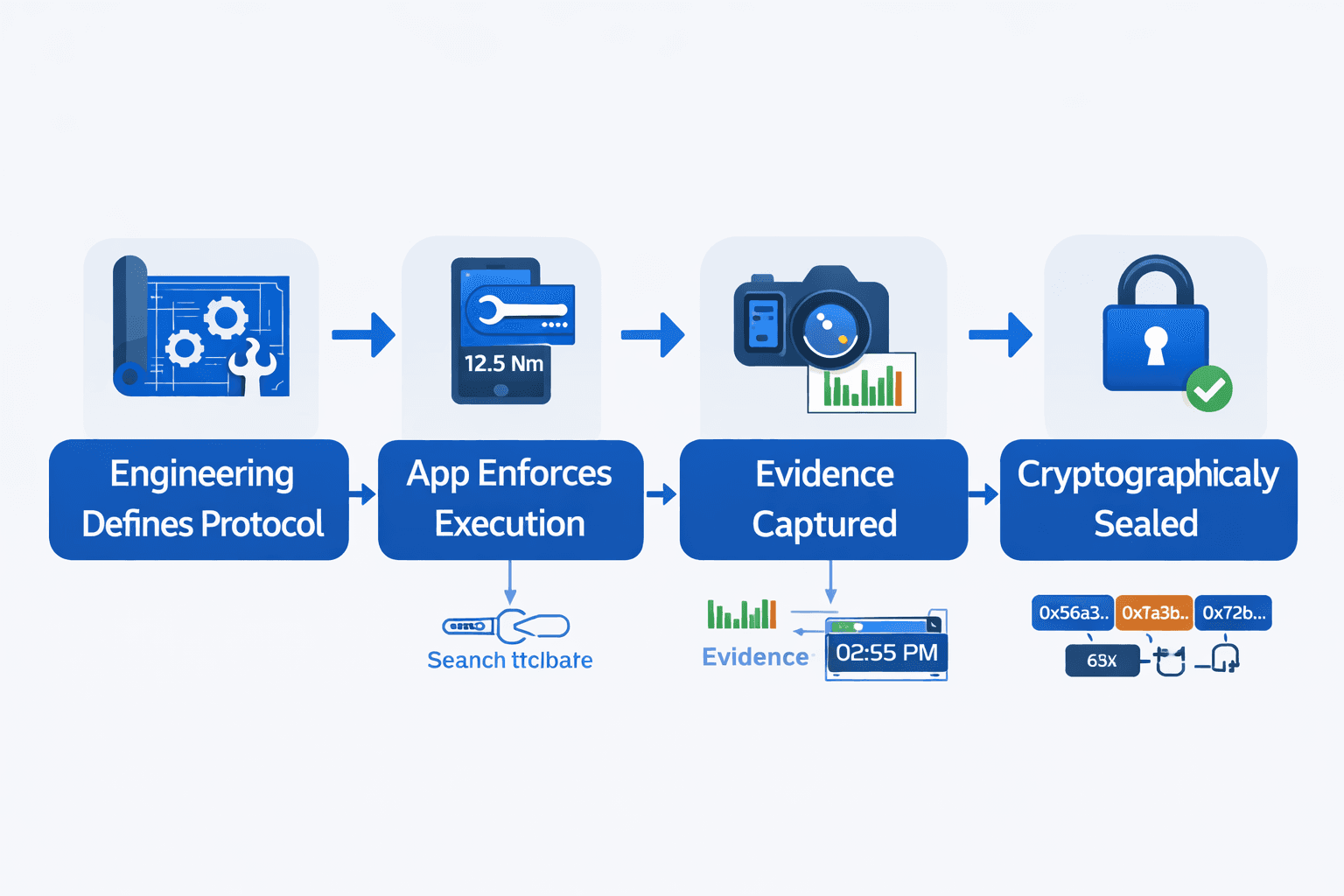
Four-step protocol flow: Define, Enforce, Capture, Seal
Engineering Defines the Protocol
Your engineering team encodes the production sequence as a protocol. This is not a checklist. It is a structured definition of what must happen, in what order, with what evidence:
- Sequential steps: Mount component, apply torque, verify alignment, capture photo
- Evidence requirements: Torque sensor reading + timestamp + operator fingerprint
- Conditional logic: If torque reading is out of spec, trigger rework protocol
- Time constraints: Curing must complete for 30 minutes before next step
The protocol is versioned. Changes are tracked. Everyone executes the same version per production run.
The App Enforces Execution
Operators on the production floor use the Pruved app. The app loads the protocol. It enforces the sequence. It cannot be skipped, reordered, or bypassed:
- Step-by-step guidance: Operators see exactly what to do next
- Evidence capture: Photo, sensor data, barcode scan, GPS, timestamp captured in real-time
- Device fingerprint: The specific device and operator are recorded
- No shortcuts: Cannot proceed to next step until current step evidence is captured
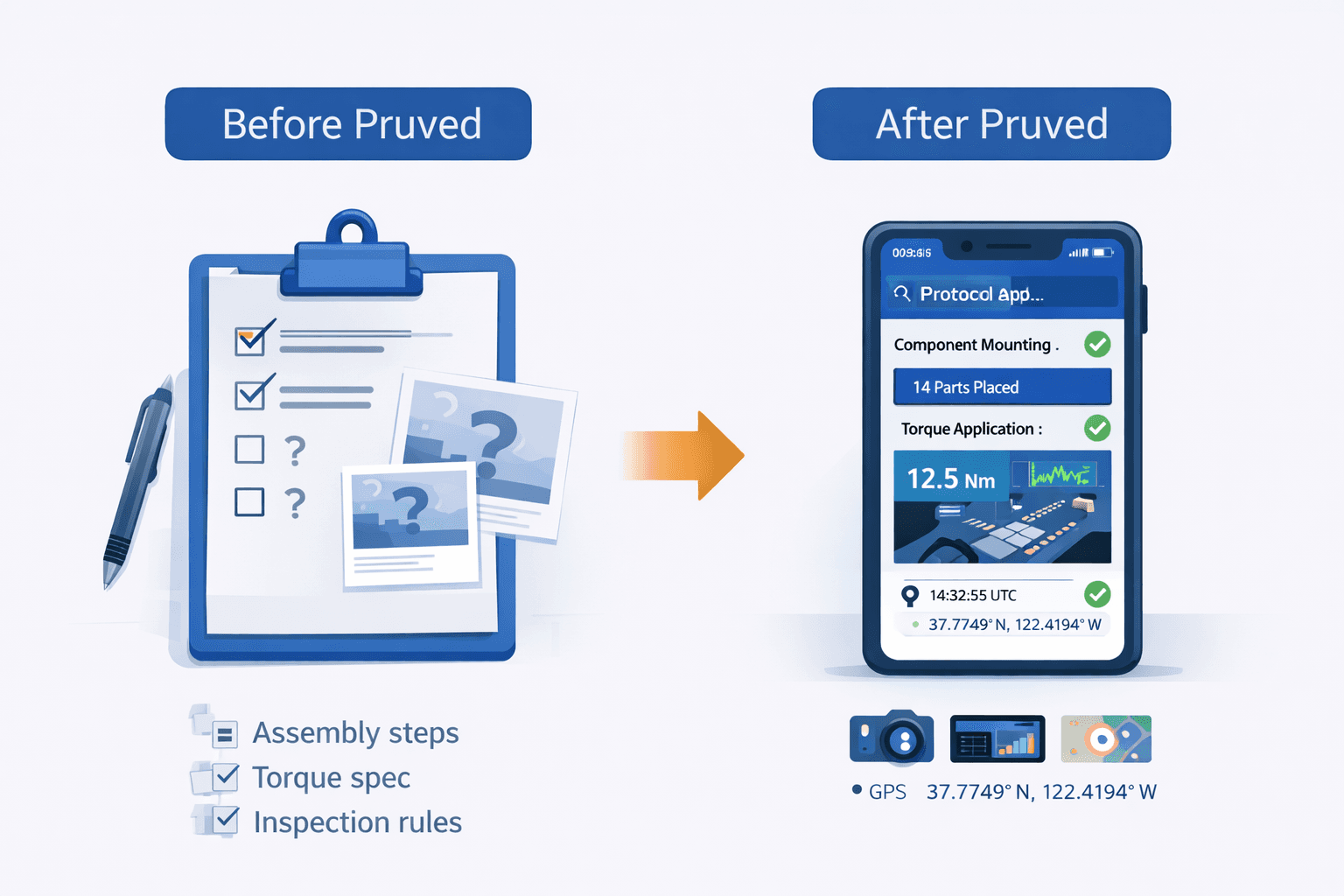
Manual vs. Protocol-Driven Documentation
Cryptographically Sealed Records
As each step completes, the evidence is cryptographically sealed. The seal is a hash of the evidence + metadata + previous step hash. This creates a tamper-proof chain:
- Immutable timeline: Cannot alter the sequence or timestamps after the fact
- Verifiable evidence: Photos, sensor data, and measurements are bound to the specific step and operator
- Audit trail: Every step shows who did what, when, where, and with what device
- Version proof: The exact protocol version used is locked in the record
Proof Replay for Quality Assurance
After production, quality assurance teams can replay the exact execution. No guesswork. No asking operators what happened. The proof shows:
- Every step performed: In order, with timestamps
- All evidence captured: Photos of component installation, torque sensor readings, alignment measurements
- Operator accountability: Who performed each step
- Exception handling: If a step failed or required rework, the full context is visible
Production Floor Evidence Types
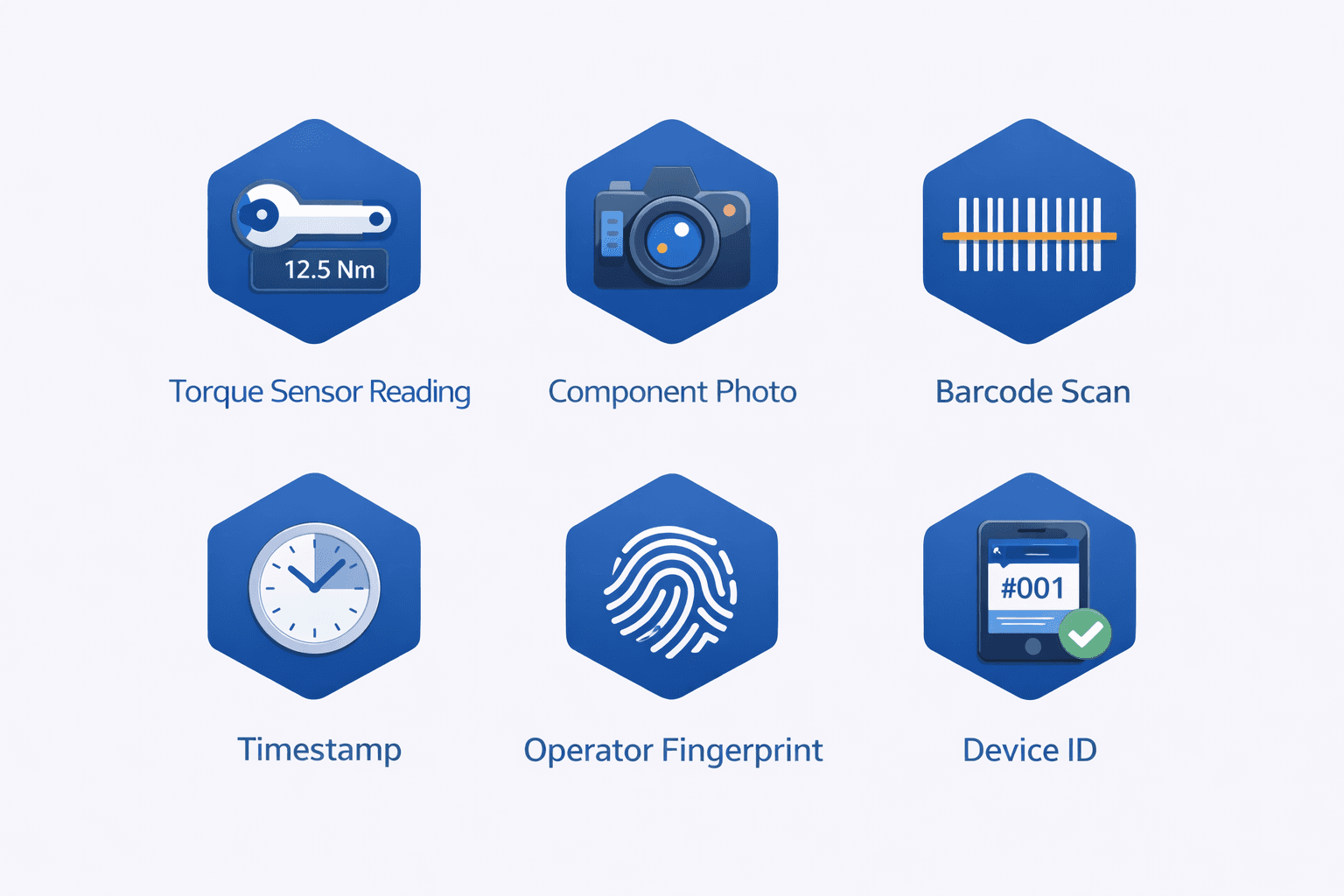
Six key evidence types captured automatically at each production step
Real-World Production Applications
Automotive Component Assembly
Every vehicle component must meet spec. Engine assembly, brake systems, electrical harnesses. Protocol-driven verification ensures:
- • Correct torque applied to every bolt
- • Genuine parts verified via barcode scan
- • Visual inspection photos captured
- • Real-time deviation alerts
Electronics Manufacturing
Circuit board assembly requires precision. Solder joints, component placement, functional testing. Protocols capture:
- • Reflow temperature profiles from sensors
- • Automated optical inspection results
- • Functional test pass/fail with full data
- • Traceability to component lot numbers
Medical Device Production
FDA-regulated production requires complete traceability. Protocols provide:
- • Device history record for every unit
- • Material traceability from raw goods to finished device
- • Environmental monitoring (temperature, humidity during production)
- • Operator training verification before production
Implementing Production Verification
Start with One Production Line
You do not need to digitize your entire facility at once. Start with one production line. One product. Encode the protocol. Train operators. Run a pilot.
Define Evidence Requirements
Not every step needs a photo. Not every measurement needs sensor integration. Focus on critical control points:
- • Steps with tight tolerances
- • Steps that frequently cause downstream issues
- • Steps required for regulatory compliance
- • Steps that determine product safety
Integrate with Existing Systems
Pruved integrates with your existing manufacturing execution systems (MES), quality management systems (QMS), and ERP. Production verification records flow into your existing infrastructure without replacing it.
The Bottom Line
Production line verification is not about surveillance. It is about certainty. When a unit leaves your production line, you have cryptographic proof that every critical step was completed correctly.
No more relying on memory. No more batch-level approximations. No more editable records. Just verifiable proof that your production process was followed.
Ready to Verify Your Production Line?
See how protocol-driven verification works on your production floor.
Get Started