Assembly Process Documentation
Capturing every torque spec, alignment check, and component installation with verifiable evidence.
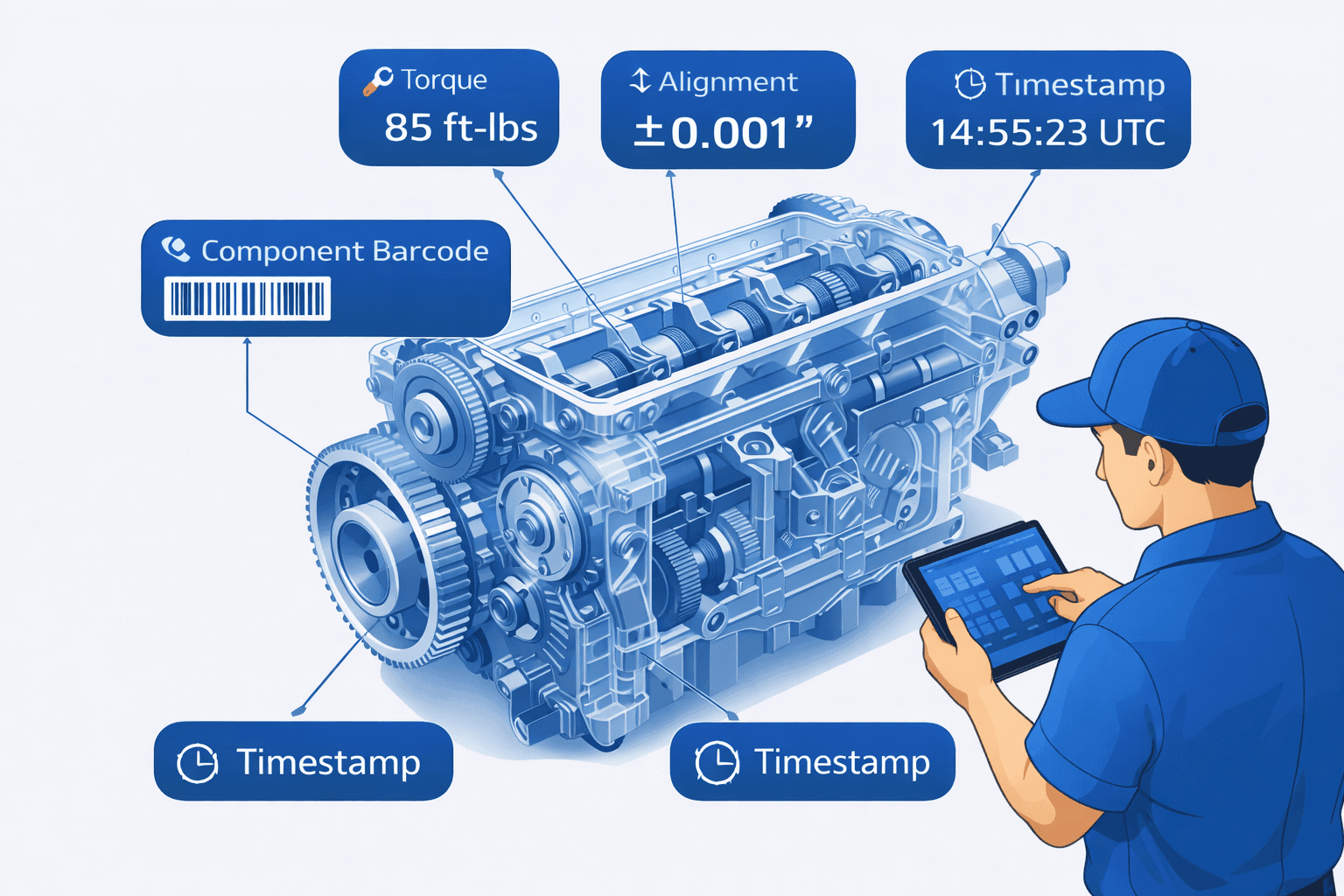
Assembly Is Where Specifications Become Reality
Complex assemblies require hundreds of precise steps. Bolt patterns with specific torque values. Component alignments with tight tolerances. Installation sequences that cannot be reversed. Each step matters.
When assembly is complete, the question is simple: was it done correctly? Paper checklists say yes. Photos prove some steps happened. But neither provides cryptographic proof that every specification was met.
The Assembly Documentation Gap
Traditional assembly documentation fails in predictable ways:
Torque values recorded without verification
Technician writes "85 ft-lbs" on the form, but was the torque wrench calibrated? Was it actually applied?
Photos without context
A photo of an installed component does not show if it was installed in the correct sequence or orientation
Checklists completed in bulk
Multiple steps checked off at once, rather than step-by-step verification
No audit trail
Cannot determine who performed which step, or when
The result: when a failure occurs downstream, you cannot definitively prove whether assembly was the root cause.
Protocol-Driven Assembly Documentation
Pruved treats assembly as a protocol. Every step is defined. Every step is enforced. Every step is verified with evidence. Every record is cryptographically sealed.
Engineering Defines Assembly Protocols
Your engineering team encodes the assembly procedure as a protocol. This is not a PDF instruction manual. It is a structured definition of what must happen:
- Sequential steps: Install bearing housing, torque bolts to spec, verify alignment, apply sealant
- Evidence requirements: Torque wrench sensor data + photo of installed component + alignment measurement
- Conditional branching: If alignment is out of tolerance, trigger re-work sub-protocol
- Component verification: Scan part barcode to verify correct component before installation
The protocol is versioned. Every revision is tracked. Every assembly uses a specific protocol version.
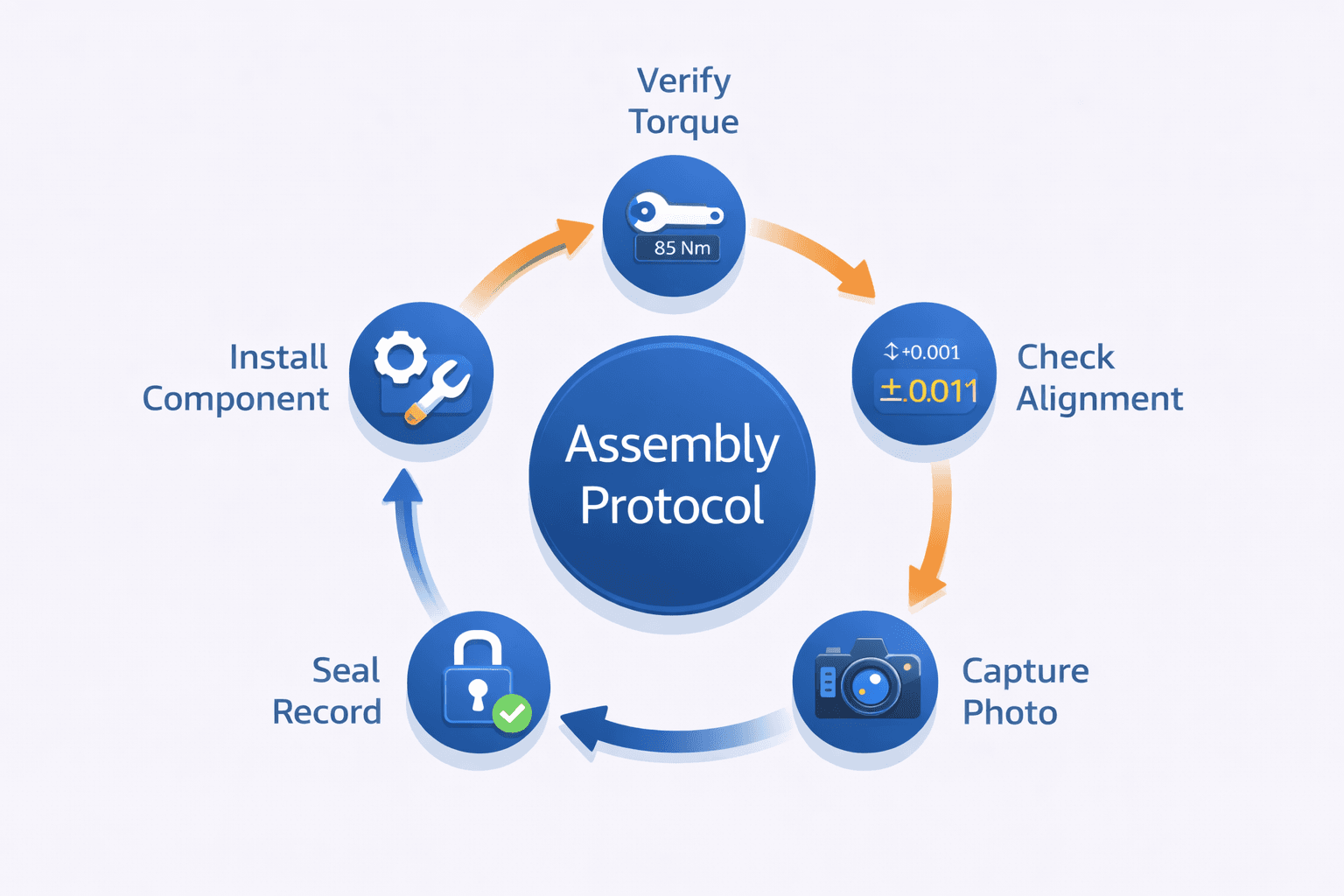
Protocol-driven assembly ensures every step follows a defined sequence with verifiable evidence
The App Enforces Assembly Sequence
Assembly technicians use the Pruved app on the shop floor. The app loads the protocol. It guides them through each step. It enforces the sequence:
- Step-by-step guidance: Clear instructions for each step
- Real-time evidence capture: Photo of component, torque sensor reading, alignment measurement, timestamp
- Cannot skip steps: Must complete current step before proceeding to next
- Device and operator fingerprint: Records who did the work and on what device
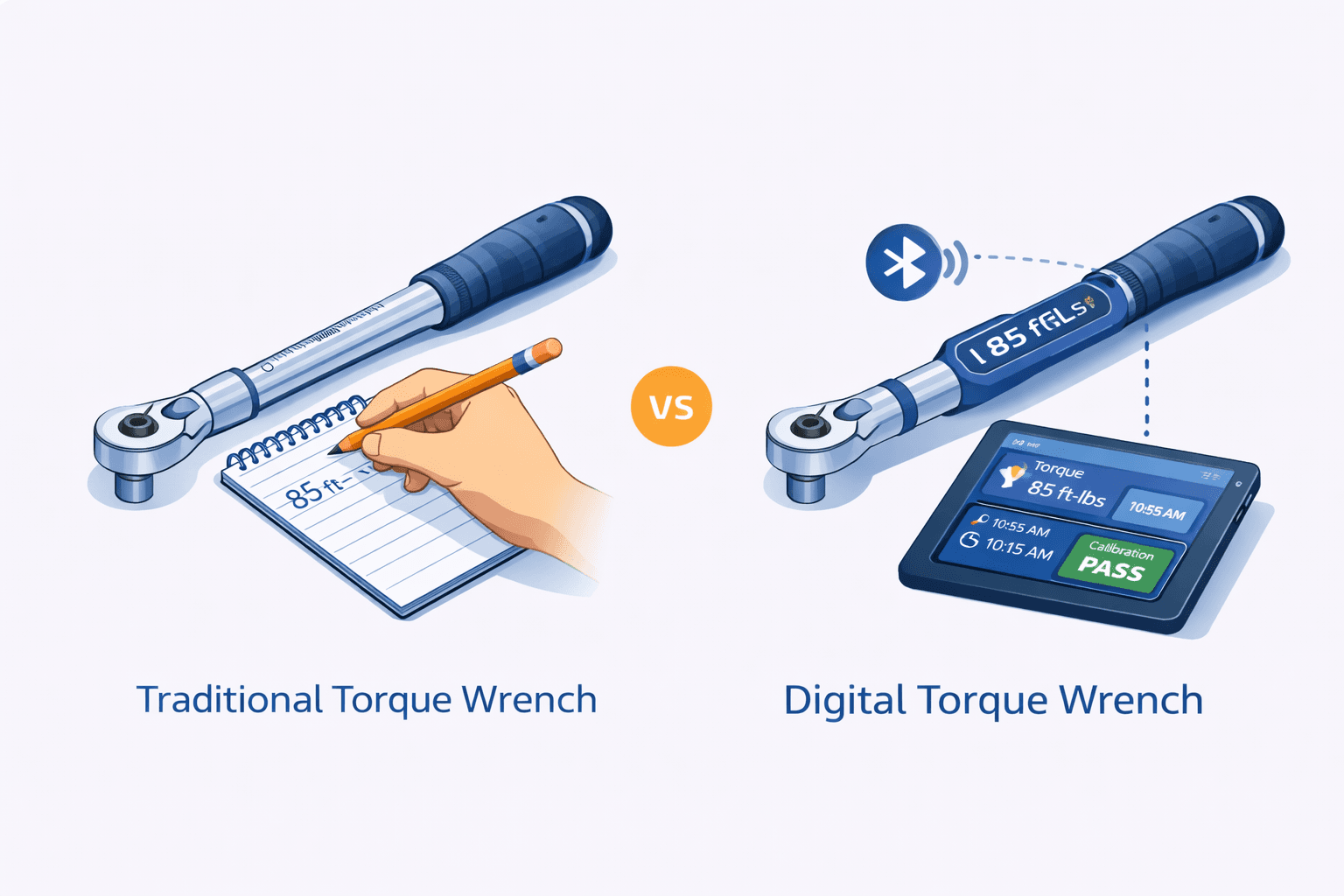
Real-time torque sensor integration provides cryptographic proof of proper assembly
Real-World Assembly Applications
Aerospace Component Assembly
Aircraft assembly demands absolute precision. Every bolt has a torque spec. Every wire harness has a routing path. Protocols capture:
- • Torque applied to every fastener with sensor verification
- • Visual inspection of every installation with photos
- • Component serial numbers for full traceability
- • Technician certification verified before assembly begins
Heavy Equipment Assembly
Mining equipment, construction machinery, and industrial systems require robust assembly documentation:
- • Hydraulic fitting torque with pressure test results
- • Bearing clearance measurements
- • Shaft alignment verification
- • Lubrication application with product lot numbers
Electronics and Instrumentation Assembly
Precision instruments and electronic assemblies have tight tolerances:
- • Connector insertion force measurements
- • Optical alignment for laser systems
- • Thermal compound application verification
- • Functional testing at assembly milestones
Implementing Assembly Documentation
Start with Critical Assemblies
You do not need to protocol-ize every assembly at once. Start with high-value or high-risk assemblies:
- • Assemblies with frequent quality issues
- • Assemblies with safety-critical components
- • Assemblies with regulatory requirements
- • Assemblies with warranty exposure
Define Critical Control Points
Not every step needs sensor integration. Focus evidence capture on steps that determine quality:
- • Torque-critical fasteners
- • Alignment-sensitive installations
- • Component orientation verification
- • Seal and gasket installation
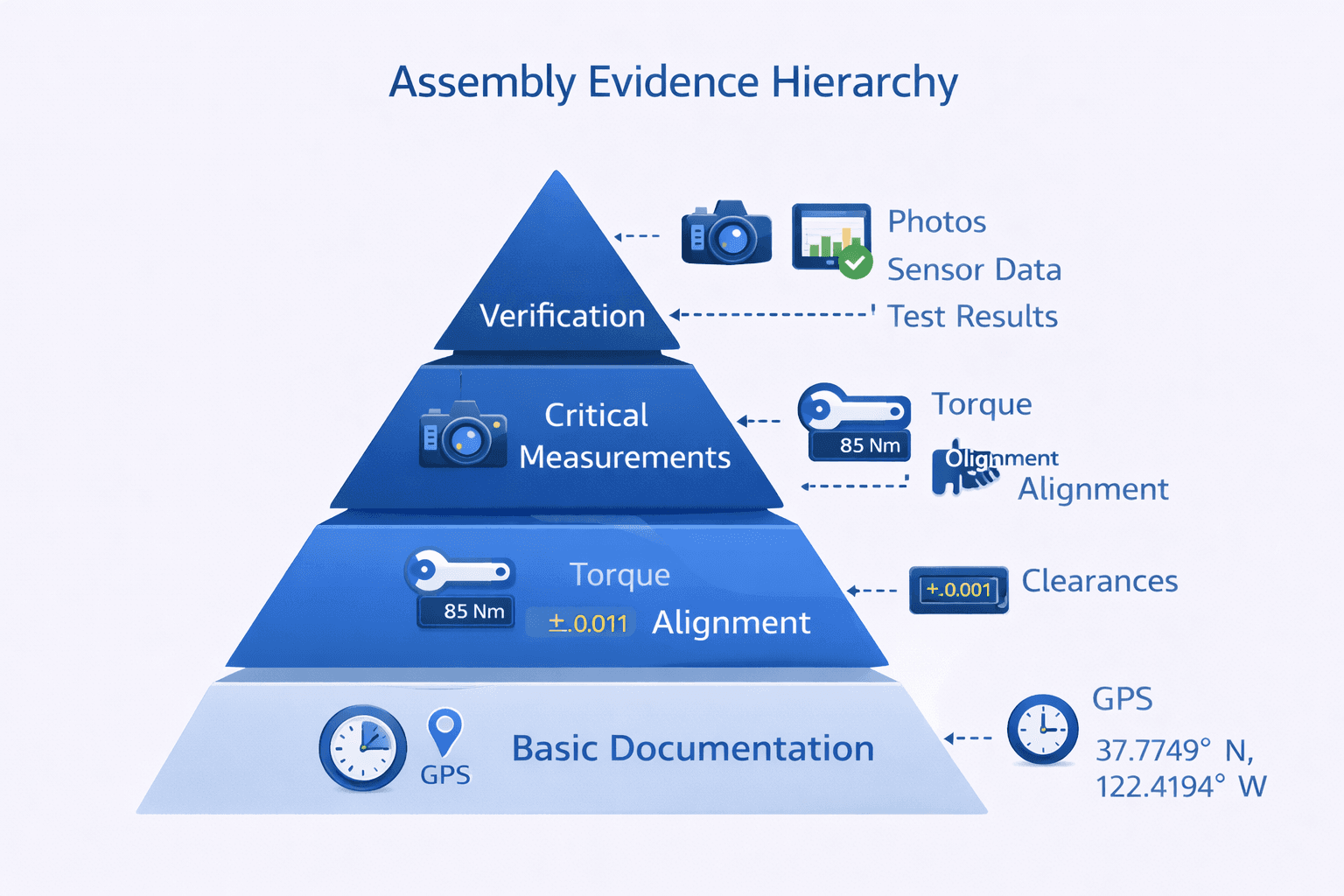
Evidence hierarchy prioritizes automated sensor capture with visual verification as backup
Integrate with Assembly Tools
Modern torque wrenches, measurement devices, and barcode scanners support digital integration. Pruved connects to these tools to capture evidence automatically without slowing down the assembly process.
The Bottom Line
Assembly documentation should answer one question with certainty: was this assembled correctly? Not "probably" or "according to the checklist." Actually correctly.
Protocol-driven assembly documentation provides that certainty. Every torque spec verified. Every alignment measured. Every installation photographed. Every step sealed cryptographically.
When an assembly leaves your shop floor, you have proof that it was built to specification.
Ready to Document Your Assembly Process?
See how protocol-driven assembly documentation works in your shop.
Get Started