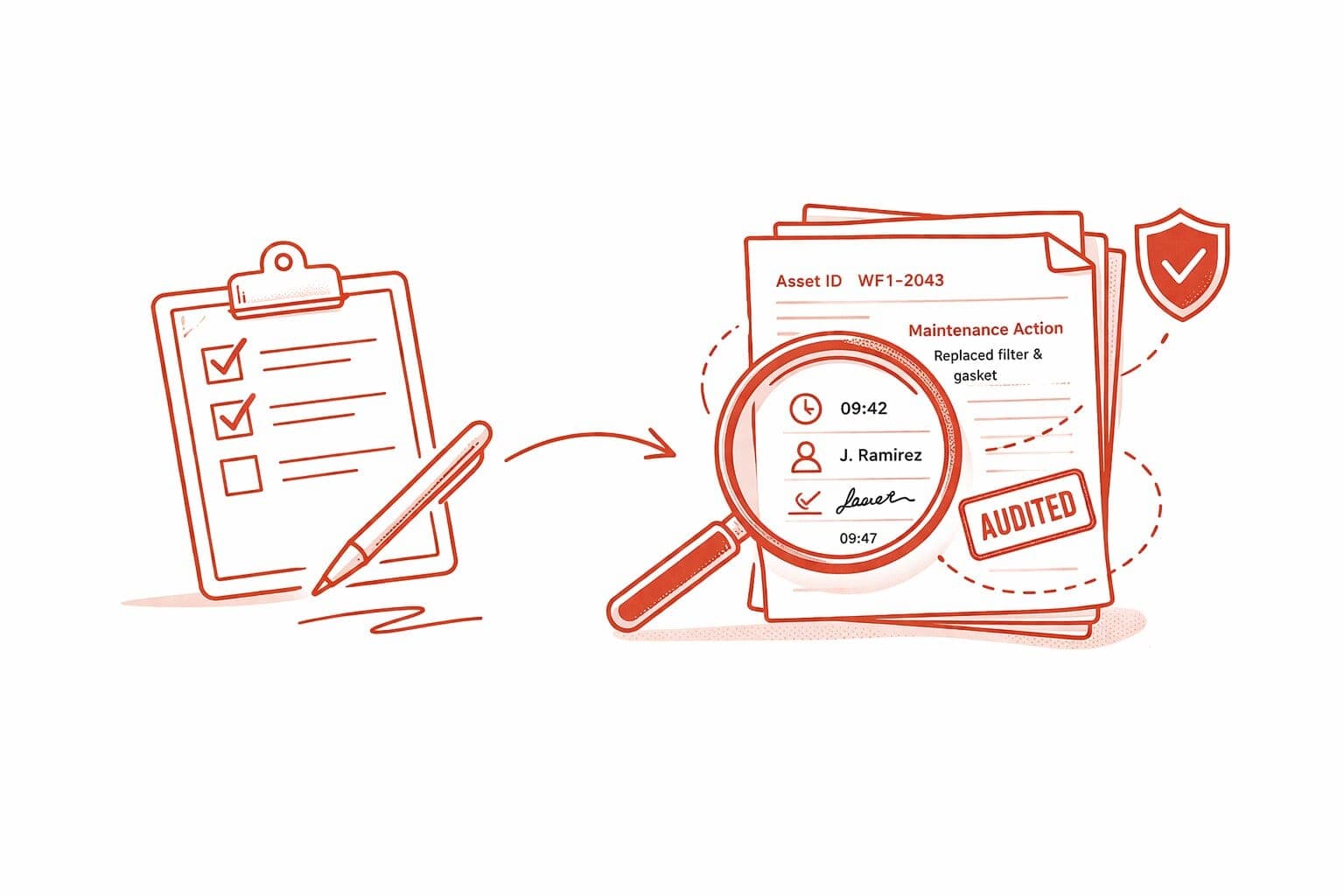
In pharmaceutical plants, medical device facilities, and food manufacturing sites, preventive maintenance is not optional.
The equipment must be maintained. The maintenance must be documented. The documentation must survive an inspection.
Most of it does not.
The PM Record Problem
A maintenance technician completes a quarterly PM on a water-for-injection system. It takes three hours. At the end, they fill out the work order: checked the filters, replaced the gasket, ran the test cycle, all boxes ticked, signed and dated.
The PM record shows that the work was reported. It does not show that the work was executed in the order specified by the procedure, at the time it was claimed, by the operator who signed it.
An FDA inspector looking at that record has one question before any other: how do I know this was not filled in after the fact?
The checkbox cannot answer that. The signature at the bottom cannot answer that. The date, handwritten on a paper work order at the end of a shift, cannot answer that.
This is not a hypothetical problem. Equipment maintenance records are a recurring finding in FDA 483 observations and EU-GMP deviations. The finding is almost never "the maintenance was not done." The finding is: the record does not demonstrate that the maintenance was done as specified.
What ALCOA+ Actually Requires
ALCOA+ is the data integrity framework applied to all records in regulated environments, including maintenance records. Contemporaneous is the principle that defeats most PM documentation systems.
Contemporaneous means the record was created at the time the work was performed. Not at the end of the shift. Not when the supervisor asked everyone to catch up on paperwork. At the time of each step.
A PM work order filled after three hours of maintenance is not contemporaneous. It is a reconstruction. The technician is recording what they remember doing, in whatever order they remember doing it, with timestamps that reflect when they sat down to write, not when they turned the wrench.
For a data integrity auditor, a reconstruction is not a record. It is an assertion.
ALCOA+ also requires attributability: each action must be traceable to the specific person who performed it. A single signature at the bottom of a ten-step PM procedure does not attribute each individual step to a specific operator. It attributes the entire document to whoever signed at the end.
If two technicians shared the PM, the record typically cannot show who did which steps, in what order, or when.
The GMP Maintenance Scenario
A medical device manufacturer runs a preventive maintenance program on their cleanroom HVAC units. The procedure has eight steps: filter inspection, pressure differential check, seal integrity verification, particle count, and so on.
During a routine GMP audit, the inspector pulls three PM records for the same unit across the past twelve months. All three show the same sequence. All three are signed by different technicians. All three have timestamps rounded to the hour.
The inspector asks: can you show me the actual sequence of steps as they were performed?
The work order cannot show this. It has eight rows. It does not have timestamps per step. It does not have the differential pressure reading from step three with a time attached to it. It does not have evidence that the seal integrity result was captured before step five began.
The inspector asks: your procedure requires a supervisor countersignature on step six. Can you show that the countersignature occurred before step seven was started?
A paper form cannot answer this. A PDF export of a spreadsheet cannot answer this. A signature at the bottom of the page proves nothing about sequence.
These are standard GMP audit questions. The expectation from EU-GMP Annex 1 and the MHRA data integrity guidance is that maintenance records demonstrate the work was performed as specified, not merely that it was reported.
What CFR Part 11 Looks Like for Maintenance
21 CFR Part 11 governs electronic records and electronic signatures in FDA-regulated environments. For maintenance records, this means that any electronic PM log must produce a time-stamped, operator-attributed audit trail that shows what was recorded and when.
Many facilities treat this as a document control problem. They digitize the work order, apply an electronic signature, store it in a validated system. Done.
This misses what Part 11 is actually asking for.
Part 11 requires that the electronic record accurately reflects the work that was performed and that the system prevents backdating and unauthorized alteration. A digitized work order filled in after the fact, signed electronically at the end, does not satisfy this. The audit trail shows when the form was submitted. It does not show what happened between the technician opening the form and clicking submit.
A PM execution record built step by step in the field produces the Part 11 audit trail as a natural output of the work. Each step is logged when it is completed. Each measurement is timestamped when it is entered. The sequence is not reconstructed at the end. It is the record.
Beyond the Checklist
Preventive maintenance has always been done on checklists because checklists are simple and portable. That is not the problem.
The problem is that a checklist filled after the work is done is a narrative, not a record. It tells the inspector what the technician remembers. A record built during the work tells the inspector what actually happened.
For GMP and FDA-regulated facilities, that distinction is the difference between an audit finding and a clean record.
If this is the kind of specifics you are working through, the next posts go into what ALCOA+ requires at the individual step level for maintenance procedures, how Annex 11 applies to maintenance execution systems, and where CFR Part 11 audit trails break down in practice for PM records.